

Pallet Netting Wrap: Specs, Grades, Sizes & Uses
Pallet netting wrap from a manufacturer — how knitted HDPE netting stabilizes loads, when to choose elastic or non-elastic grades, and which widths fit your line.
August 14, 2026
Once a load is stacked on a pallet, it still has to survive forklifts, truck beds, sea containers and a warehouse floor before anyone opens it. Plastic stretch film has handled that job for decades, but a growing number of warehouses, co-packers and distributors are switching part or all of their pallet line over to Tiandi Pallet Netwrap instead. The same pallet-netting questions were discussed at World Ag Expo 2026 in Tulare, where Tiandi displayed pallet wrapping net alongside bale netwrap.
The reasons are rarely about a single dramatic failure. They are usually about ventilation, material cost per pallet, and how a load behaves once it is wrapped — issues that only show up after months of running film on the wrong product.
This guide explains what Pallet Netting Wrap is, how it is constructed, where it outperforms stretch film, and what buyers should check before choosing a product or a manufacturing partner. For a focused produce application, see pallet netting for fresh produce; for wholesale procurement, use the pallet net wrap supplier checklist.
For a recent example of how agricultural netting is discussed with machinery and agribusiness buyers, see the Tiandi Netwrap report from Henty Machinery Field Days 2026.
For deeper comparisons and technical detail, browse the full Knowledge Center or follow the guides linked throughout this page.
In This Guide
What Is Pallet Netting Wrap?
How Is Pallet Netting Wrap Made?
Pallet Netting Wrap vs Stretch Film
Elastic vs Non-Elastic Pallet Netting
Which Loads Suit Pallet Netting Wrap?
How Do You Choose the Right Width and Length?
What Should Buyers Check Before Ordering?
How Do You Evaluate a Pallet Netting Wrap Manufacturer?
Frequently Asked Questions
A. What Is Pallet Netting Wrap?
Pallet Netting Wrap is a knitted HDPE mesh that stretches over a palletized load to hold it together during handling, storage and transport. It is also sold under names such as pallet net wrap, netted pallet wrap, pallet netting stretch wrap, plastic pallet netting, pallet mesh wrap and mesh pallet wrap. Buyers specifying by function often call it pallet containment netting, since containment force — not surface coverage — is what actually holds the stack.
Unlike stretch film, which is a continuous plastic sheet wound in overlapping layers, Pallet Netting Wrap is an open weave structure — you can see daylight through it. The knit carries the tension needed to compress the load, while the gaps between filaments let air move freely through the pallet.
A wrapping machine or operator stretches the net over the stacked load in a small number of passes, applying even compression from the top of the stack down to the base.
Stabilize boxes, bags and crates against shifting
Allow air to circulate through the load
Use far less material per pallet than film
Conform to irregular or mixed-SKU stacks
Reduce condensation risk on goods that release moisture
For a full technical breakdown of the knit itself, see the dedicated guide: Open Weave Pallet Netting Explained: How It Works and When to Use It.
B. How Is Pallet Netting Wrap Made?
Pallet Netting Wrap starts as HDPE resin, which is extruded and drawn into monofilaments and then warp-knitted into a wide diamond-pattern mesh — the same underlying process family used for bale net wrap, adapted for pallet-scale widths and a different balance of stretch and containment force.
Two production variables matter most for how the finished net performs on a pallet:
Filament strength and drawing
The filament diameter and molecular orientation set the balance between tensile strength and elongation. A net that is too stiff will not conform to an irregular stack; a net that is too weak will not hold containment force over the length of a shipment.
Knitting tension and mesh uniformity
Uneven knitting tension produces a mesh that stretches unevenly across its width, leaving parts of the load under-compressed while other sections are over-tightened. Consistent knitting is what lets the same roll perform the same way from the first pallet to the last.
HDPE is preferred over lighter-gauge materials because it holds tensile strength under sustained stretch, resists the abrasion of repeated pallet edges, and tolerates the temperature range of trucks, containers and outdoor yards.
C. Pallet Netting Wrap vs Stretch Film
Both materials do the same basic job — keep a stacked load from shifting or toppling — but they behave very differently once applied.
Pallet Netting Wrap vs Stretch Film
| Evaluation Factor | Pallet Netting Wrap | Stretch Film |
| Structure | Open weave knitted mesh | Continuous solid sheet |
| Ventilation | Air moves freely through the load | Seals the load almost completely |
| Material per pallet | Far fewer passes, less plastic used | Many overlapping layers required |
| Best suited to | Bagged, irregular or moisture-releasing goods | Uniform, dry, stackable cartons |
| Condensation risk | Low — moisture can escape | Higher on goods that sweat or off-gas |
| Load conformity | Stretches to fit uneven stacks | Corners and gaps on irregular loads |
| Cost per kilogram | Typically higher | Typically lower |
Stretch film is not obsolete. For dry, uniform cartons where a fully sealed, dust-tight finish matters more than airflow, film's lower per-kilogram cost can still make it the better choice.
Read the full comparison: Stretch Film for Pallet Wrapping vs. Pallet Net Wrap
| Buyer Tip Do not choose between netting and film on price per kilogram alone. Compare total material used per pallet, plus any downstream cost from condensation damage, dust exposure or handling time. |
D. Elastic vs Non-Elastic Pallet Netting
Pallet Netting Wrap is supplied in elastic and non-elastic constructions, and the right choice depends on the shape and rigidity of the load rather than personal preference. Tiandi's pallet net wrap range offers both, so the construction can be matched to the load rather than compromised on.
Elastic netting
Elastic netting stretches around the load and holds it under continuous tension. It suits uneven or mixed-SKU pallets, bagged goods, and stacks that are not a clean rectangle, because the net keeps adjusting to the load shape rather than sitting loose at the gaps.
Non-elastic netting
Non-elastic netting applies a fixed containment force without ongoing stretch. It is a better fit for rigid, uniform loads where consistent pressure is wanted without the net continuing to tighten — and tighten further — over time in storage.
Neither construction is universally "stronger." The right one is the one that matches how the load is shaped and how long it will sit wrapped before it moves again.
E. Which Loads Suit Pallet Netting Wrap?
The same net is specified as industrial pallet netting for manufacturing and distribution loads, and as produce pallet netting where the goods respire. Buyers may also see the category described as open-weave pallet netting, woven pallet netting or palletisation nets; those terms describe the application vocabulary, while the actual construction still needs checking. It is used across a wide range of palletized goods, including:
Bagged animal feed and fertilizer
Building materials and construction bags
Produce and other ventilation-sensitive goods
Crates and rigid cartons
Mixed-SKU or irregular retail pallets
Freshly packed or slightly damp goods
General warehouse and distribution loads
The common thread across these categories is that airflow, load shape or material savings matter more than a fully sealed, dust-tight finish. That is largely a function of the mesh itself — see Open Weave Pallet Netting Explained for why the open structure matters so much for ventilation-sensitive goods. Netting is not the only breathable option on the market, either; vented pallet wrap covers the alternatives and where each one holds up. For loads that genuinely need to be sealed against dust or moisture ingress from outside, stretch film usually remains the better tool — see Pallet Net Wrap vs. Stretch Film for where that line falls.
F. How Do You Choose the Right Width and Length?
Pallet Netting Wrap rolls are supplied in standard widths and roll lengths, with custom sizes available for non-standard pallets or load heights.
The correct width depends on load height and stack shape rather than roll length alone. A narrower roll suits shorter or lighter stacks; a wider roll gives fuller coverage on taller pallets in fewer passes.
Load height and stack profile
Number of passes required for full coverage
Elastic vs non-elastic construction
Pallet footprint and load weight
Wrapping method (manual or machine)
Storage duration before the load ships
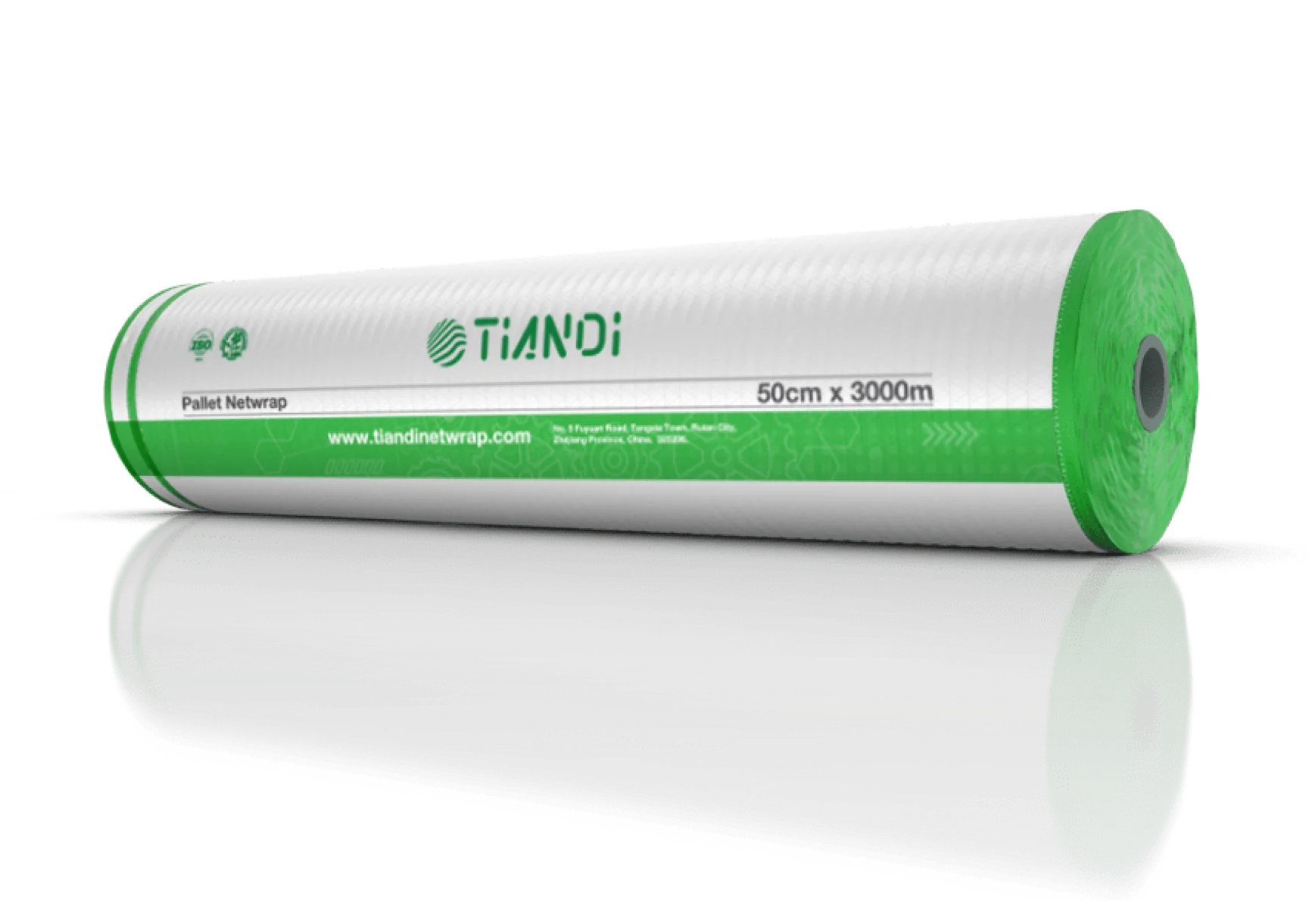
As a reference point, Tiandi's standard Pallet Netwrap range covers 50cm and 76cm widths on 1,000m and 3,000m rolls, with custom widths and lengths available on request. Full specifications, including weight per roll and rolls per pallet, are on the pallet wrapping net product page.
G. What Should Buyers Check Before Ordering?
Before comparing quotations, buyers should define the load type, containment requirement and destination market.
Pallet Netting Wrap buyer checklist
Is the width matched to your load height and pallet footprint?
Is elastic or non-elastic construction specified?
What raw material is used, and is it virgin HDPE?
Is actual roll length controlled and verified?
Is winding tension consistent from roll to roll?
Does the net unwind smoothly on your wrapping equipment?
Are tensile and stretch properties consistent between batches?
Is the packaging suitable for export and warehouse storage?
Can each batch be traced?
Are OEM labels, colors and packaging available?
Can the supplier provide samples for line testing before a full order?
The best roll is not the one with the highest advertised strength. A net that is too stiff to conform to the load, or that unwinds unevenly on your machine, can cause more handling problems than one with balanced, well-controlled properties.
Buyers weighing net wrap against film for a specific product line can contact our team with pallet dimensions and load type for a width and construction recommendation.
H. How Do You Evaluate a Pallet Netting Wrap Manufacturer?
For distributors and private-label buyers, the manufacturing partner matters as much as the product spec sheet.
Production capability
Can the factory supply the widths, lengths, elasticity and packaging formats your operation actually needs — including custom sizes for non-standard pallets?
Quality control
Are width, roll length, tensile properties and winding quality checked during production, not just at final inspection?
Batch consistency
Does the net perform the same way across repeat orders and peak-season production runs?
Export experience
Does the manufacturer understand container loading, moisture protection, labeling and shipping documentation for your destination market?
OEM capability
Can the factory support private labels, custom cores, printed packaging and product traceability?
A supplier that also manufactures other knitted HDPE net products — such as baler net wrap — often brings deeper process control to pallet netting as well, since the underlying extrusion, drawing and knitting disciplines are shared across both product lines.
I. Frequently Asked Questions
What is pallet netting wrap used for?
Pallet netting wrap stretches over a palletized load to stabilize boxes, bags or crates during storage and transport, often replacing or supplementing stretch film and strapping.
Is pallet netting wrap stronger than stretch film?
Strength is not the right comparison. Netting and film apply containment differently — netting compresses through a knitted mesh with open gaps, film seals through a solid layered sheet. The better choice depends on whether the load needs to breathe or needs to be sealed; see the full Pallet Net Wrap vs. Stretch Film breakdown for load-by-load guidance.
Can pallet netting wrap be used outdoors or in export containers?
Yes, provided the width, construction and packaging are matched to the load and shipping conditions. Buyers should confirm expected transit time and storage conditions when specifying a roll.
Does pallet netting wrap replace strapping?
Not always. Netting distributes containment force across the load surface, which is gentler on soft or bagged goods than strapping. Some operations use netting and light strapping together for heavier or taller loads.
How do I know whether to choose elastic or non-elastic netting?
Elastic netting suits irregular, mixed-SKU or bagged loads that need the net to keep adjusting to the load shape. Non-elastic netting suits rigid, uniform loads where a fixed containment force is preferred.
Can pallet netting wrap be recycled?
Used HDPE netting may be recyclable where suitable plastic collection programs exist. It should be kept clean and dry and separated from other packaging materials according to local recycling requirements.
J. Build a More Reliable Pallet Netting Wrap Supply Program
Choosing Pallet Netting Wrap should not be reduced to comparing price per kilogram against stretch film.
Reliable performance comes from the combination of:
Appropriate HDPE raw material
Controlled filament drawing
Stable, uniform knitting
Correct elastic or non-elastic construction
Accurate roll winding
Consistent quality control across batches
Width and length matched to the actual load
A manufacturer with real export and OEM experience
Warehouses need a roll that behaves predictably on the wrapping line. Distributors need consistency across shipments. OEM buyers need a manufacturer that can support specifications, packaging and branding at volume.