
Pallet Net Wrap Application: Coverage, Cost & Faults
Pallet net wrap application in a warehouse — coverage per load, cost against stretch film, manual and machine setup, and fixes for common faults.
August 15, 2026
Most warehouses already know pallet net wrap exists. Fewer have worked out exactly where it earns its place on the wrapping line, so this pallet net wrap application guide focuses on how much a given load actually needs and what to do when a roll starts causing problems instead of solving them.
That gap between knowing the material and running it well is where most of the value — and most of the avoidable cost — sits.
This guide focuses on the practical side: which operations get the most out of pallet net wrap, how it is actually applied by hand and by machine, how to calculate real coverage and cost per pallet, and how to fix the handful of problems that account for almost every field complaint. For a produce-specific application, see pallet netting for fresh produce; for supplier due diligence, use the pallet net wrap supplier guide.
For a full explanation of what pallet net wrap is and how it is built, see What Is Pallet Netting Wrap? first. This guide picks up from there.
In This Guide
What Makes Pallet Net Wrap Worth Switching To?
Which Industries Get the Most Value from Pallet Net Wrap?
How Is Pallet Net Wrap Applied: Manual vs Machine?
How Much Pallet Net Wrap Does a Pallet Actually Need?
Elastic vs Non-Elastic Netting: Choosing in Practice
Common Pallet Net Wrap Problems and How to Fix Them
Is Pallet Net Wrap Recyclable?
Pallet Net Wrap Application Checklist
Frequently Asked Questions
A. What Makes Pallet Net Wrap Worth Switching To?
Warehouses rarely switch a wrapping line over to pallet net wrap because of a single feature. It is usually a combination of three practical outcomes that show up over weeks, not on the first pallet:
Fewer passes needed to secure a comparable load, which speeds up manual wrapping stations
Less plastic consumed per pallet, which shows up directly in per-unit packaging cost
Open weave ventilation, which reduces condensation complaints on goods that sweat, off-gas or were packed slightly damp
None of these are dramatic on their own. Across thousands of pallets a month, they compound into real savings in material spend, labor time and damaged-load claims.
If ventilation is the reason you are looking at netting in the first place, compare it against perforated film in our guide to breathable and vented pallet wrap options.
The trade-off is usually cost per kilogram — pallet netting wrap typically costs more per kilogram than commodity stretch film, even though less material is used per pallet overall. Our comparison of stretch film for pallet wrapping versus net wrap breaks down where that trade-off favors netting and where it doesn't.
B. Which Industries Get the Most Value from Pallet Net Wrap?
Pallet net wrap earns its keep fastest where load shape, ventilation, or handling gentleness matter more than a fully sealed finish.
Animal feed and agricultural inputs
Bagged feed, fertilizer and seed are dense, heavy, and often slightly irregular in stack shape. Elastic netting conforms to bag stacks better than film corners, and open weave ventilation matters when bags are packed with any residual moisture.
Building materials
Bagged cement, plaster and aggregate present the same irregular-stack problem, plus abrasive surfaces that wear on film faster than on a knitted mesh. Netting's fewer passes also mean less handling time on pallets that are already heavy to move.
Produce and perishables
Anything that continues to respire after packing — fresh produce, some baked goods, certain packaged foods — benefits directly from the open weave letting moisture and heat escape instead of condensing under a sealed film layer.
Retail and mixed-SKU distribution
Pallets built from different box sizes and shapes rarely form a clean rectangle. Elastic netting stretches to hold an uneven stack together in a way film struggles to do without gaps at the corners.
General warehousing and 3PL operations
Where pallet contents vary shipment to shipment, a netting program that works across bagged, boxed and irregular loads reduces the need to stock multiple wrapping materials for different customers.
Tiandi supplies both standard and custom pallet netting wrap widths for these categories — see the product page for the full specification table.

C. How Is Pallet Net Wrap Applied: Manual vs Machine?
Pallet net wrap can be applied by hand with a dispenser cart or by an automated stretch wrapping machine adapted for netting, and the right method depends on volume rather than load type.
Manual application
An operator pulls the net from a dispenser and walks it around the load, overlapping passes from base to top. This suits lower-volume operations, mixed load types, or facilities without dedicated wrapping equipment. Consistency depends heavily on the operator maintaining even tension on every pass.
Machine application
Turntable or rotary-arm wrapping machines built or adapted for net wrap apply consistent tension automatically and can match commercial-scale throughput. Machine application reduces the variability that comes from different operators wrapping slightly differently, which matters most for operations shipping large, repeatable pallet volumes.
What stays the same either way
Regardless of method, coverage should run from the base of the load to the top, with enough passes to hold every layer without leaving gaps at the pallet's shoulders — the same sizing principle covered in the main buyer's guide.
| Application Tip A roll that unwinds unevenly will cause inconsistent tension no matter how skilled the operator is. If passes are coming out tighter in some sections than others, check the roll and brake tension before adjusting technique. |
D. How Much Pallet Net Wrap Does a Pallet Actually Need?
Coverage is driven by load height and containment force required, not by trying to stretch a roll as far as it will go.
Taller loads need either a wider roll or more passes to reach full coverage
Denser, heavier loads generally need more containment force, which may call for non-elastic netting or additional passes
Irregular loads may need extra passes at the points where the stack narrows or bulges
Fragile or crushable goods need enough passes for stability without over-tightening
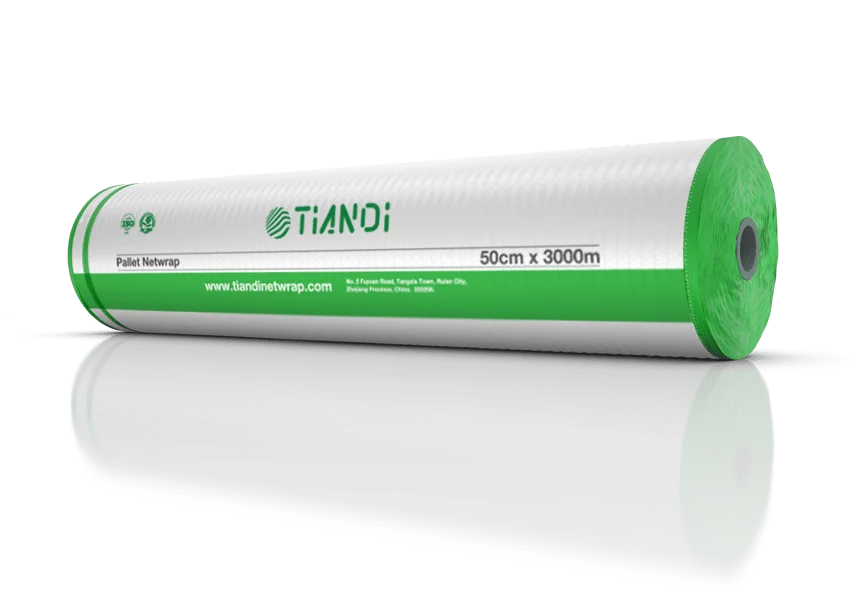
As a reference point, Tiandi's standard pallet wrapping net range runs 50cm and 76cm widths on 1,000m and 3,000m rolls. A 50cm roll typically suits shorter or lighter stacks in fewer passes; 76cm gives fuller single-pass coverage on taller pallets. Custom widths are available for pallets or load heights outside standard ranges.
Cost per pallet should be calculated on actual meters used per load, not roll price alone — a roll that requires more passes because the width doesn't match the load can end up costing more per pallet than a wider roll at a higher unit price.
E. Elastic vs Non-Elastic Netting: Choosing in Practice
The elastic-vs-non-elastic decision covered conceptually in the main guide plays out differently once it hits the floor:
Choose elastic netting when
The pallet is mixed-SKU or visibly irregular in shape
Bags or sacks need the net to keep adjusting as they settle
The load will be handled multiple times before reaching its destination
Choose non-elastic netting when
The load is rigid, uniform cartons or crates
You want a fixed containment force that won't continue tightening in storage
The goods are sensitive to ongoing compression, such as certain packaged or boxed products
Operations running both load types often standardize on elastic netting as a default and stock non-elastic for specific rigid-load lines, rather than trying to run a single construction across everything.
F. Common Pallet Net Wrap Problems and How to Fix Them
Most field issues trace back to one of three causes: roll inconsistency, wrapping technique, or a mismatch between roll and load.
Net not spreading evenly across the load
Usually a width mismatch for the load height, or uneven tension during application. Check the roll width against actual load height before blaming the material.
Load still shifting after wrapping
Often too few passes for the load weight, or non-elastic netting used on an irregular stack that needed elastic construction to keep adjusting.
Net breaking during application
Can result from a weak point in the filament, tension applied too aggressively on one pass, or a roll that has degraded from prolonged storage in poor conditions.
Roll unwinding unevenly or telescoping
A winding or packaging issue rather than an application issue — flag it with the supplier rather than reworking technique first.
Condensation still appearing under the net
Rare with true open weave netting, but possible if the load was also wrapped in a sealed layer underneath, or if ventilation around the pallet itself is restricted in storage.
If a problem persists across multiple rolls from the same batch, it's worth raising with your supplier alongside the batch number — see the manufacturer evaluation section of What Is Pallet Netting Wrap? for what a supplier should be able to explain about batch consistency.
G. Is Pallet Net Wrap Recyclable?
Pallet net wrap is made from HDPE, which is recyclable where suitable plastics collection programs exist. In practice, recyclability depends on cleanliness and separation rather than the material itself:
Keep used netting free of crop residue, product spillage or contamination
Separate it from stretch film, strapping and other packaging materials
Check local or regional plastics recycling requirements, which vary by market
Because netting uses less material per pallet than film for a comparable containment result, some operations also see it as a way to reduce overall plastic volume moving through their packaging line, independent of end-of-life recycling.
H. Pallet Net Wrap Application Checklist
Before scaling up a pallet net wrap program across a wrapping line, confirm:
Roll width matches the load height for your most common pallet type
Elastic or non-elastic construction is specified per load category, not applied uniformly
Operators are trained on consistent base-to-top passes rather than improvising coverage
Machine tension settings are calibrated for netting, not carried over from a film program
A process exists to flag roll or batch problems back to the supplier
Storage conditions for unused rolls avoid prolonged heat or UV exposure before use
Buyers scaling from a trial to a full program can contact our team with pallet dimensions, load types and current wrapping method for a specific width and construction recommendation.
I. Frequently Asked Questions
Is pallet net wrap more expensive than stretch film?
Per kilogram, usually yes. Per pallet, it depends — netting typically needs far fewer passes and less total material, which can offset the higher unit cost. See the full comparison for where each material comes out ahead.
Can pallet net wrap be used with existing stretch wrapping machines?
Some turntable and rotary-arm machines can run netting with the right tensioning setup; others are built specifically for film. Confirm compatibility with your equipment supplier before committing a full line to netting.
How many passes does a pallet need?
It depends on load height, weight and shape rather than a fixed number. Coverage should run base to top without gaps at the shoulders — start with supplier guidance for your specific roll width and adjust from trial pallets.
Does pallet net wrap work for cold storage or refrigerated loads?
Open weave netting is generally compatible with cold storage, though buyers should confirm the HDPE formulation and any UV or temperature considerations for their specific facility with the supplier.
What causes a pallet net wrap roll to telescope during unwinding?
Telescoping is typically a winding or packaging defect from manufacturing rather than an application problem. It should be reported to the supplier with the batch details rather than corrected through wrapping technique.
Can elastic and non-elastic netting be mixed on the same wrapping line?
Yes. Many operations stock both and assign construction by load category — elastic for irregular or mixed-SKU pallets, non-elastic for rigid uniform loads — rather than standardizing on a single type for everything.
J. Put Pallet Net Wrap to Work Across Your Line
Getting real value from pallet net wrap comes down to matching the roll to the load, not just switching materials and hoping the outcome improves on its own.
That means:
Choosing width by load height, not habit
Assigning elastic or non-elastic netting by load category
Calibrating application — manual or machine — for consistent tension
Tracking cost per pallet, not just cost per kilogram
Flagging batch problems to the supplier instead of absorbing them as technique issues
For the underlying material science, sizing logic and buyer checklist, start with What Is Pallet Netting Wrap? A Complete Guide for Warehouses, Distributors and OEM Buyers.