

Vented Pallet Wrap: Punched Film vs Netting
Vented pallet wrap explained: compare punched film with knitted pallet netting for airflow, material use, irregular loads and packaging-line fit.
August 16, 2026
If your pallets arrive with damp outer cartons, softened bag walls or a musty smell, the wrap is a likely cause. Sealing a load that still holds moisture traps it there for the whole journey.
Vented pallet wrap fixes this by letting the load breathe in transit. Two very different products are sold under that description, and the choice between them matters more than most buyers expect.
What vented pallet wrap actually means
Vented — also sold as vented stretch wrap, ventilated pallet wrap, vented load wrap or breathable load wrap — describes any air permeable pallet wrap that lets air move through the load rather than sealing it. Two products dominate:
- Vented stretch film — also listed as punched hole pallet wrap, breathable stretch film or breathable pallet film — is conventional LLDPE stretch film with holes punched through it. The base material is unchanged; perforation is what adds the airflow.
- Pallet net wrap is a knitted HDPE mesh. Airflow comes from the structure itself — there is no solid sheet to perforate in the first place.
Both breathe. They differ sharply in how much plastic each needs and how well each grips an irregular load.
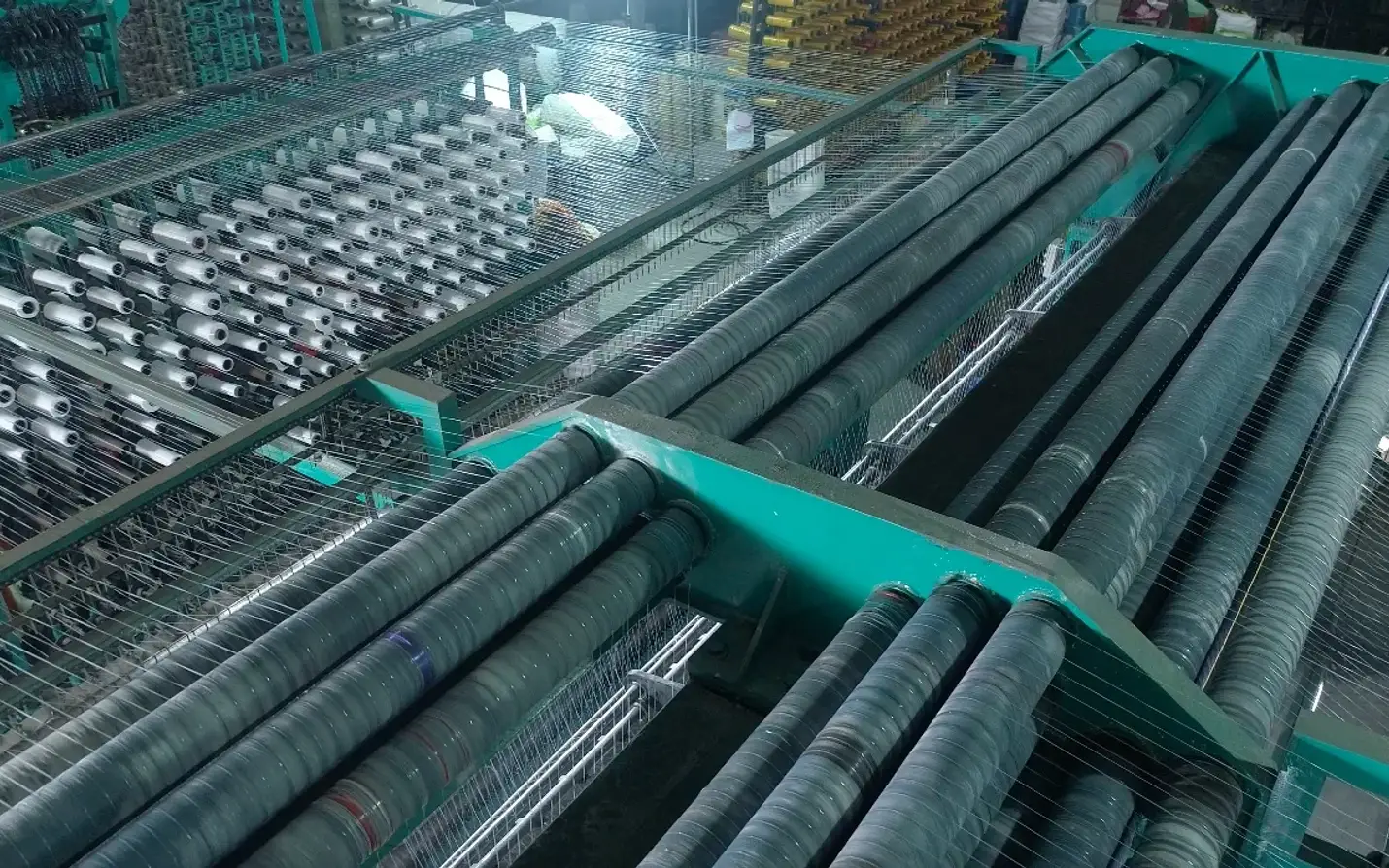
That distinction is a manufacturing one. Net wrap is knitted open from the start, so the airflow is not something added to a finished sheet — it is the sheet's absence.
Why sealed loads fail
Moisture already inside a load has to go somewhere. Produce respires. Goods packed warm and wrapped before cooling give off vapour. Bagged feed, fertiliser and building materials often carry residual damp from filling.
Under solid film that vapour condenses against the inside of the wrap, runs down the stack and soaks the outer layer. Cold-chain pallets are worst, because the temperature gap between the goods and the surrounding air drives condensation harder.
The damage shows up at the receiving end rather than at dispatch, which is why it usually surfaces as a claim rather than as an inspection failure.
Vented stretch film vs. pallet net wrap
| Vented stretch film | Pallet net wrap | |
|---|---|---|
| Structure | Perforated LLDPE sheet | Knitted HDPE mesh |
| Airflow path | Punched holes only | The full weave |
| Passes per pallet | 15–20 | 3–5 |
| Plastic per pallet | High | Much lower |
| Irregular loads | Tears at perforations on corners | Mesh conforms and holds |
| Load visible for inspection | Limited | Full |
Perforating a film weakens it. The holes concentrate stress, so vented film tends to split along the perforation line at sharp corners — precisely where containment matters most. A knitted mesh has no equivalent weak point, because tension runs along the filaments rather than across a thin sheet. Our comparison with solid stretch film works through the cost per pallet in detail.
Choosing the right breathable option
- Produce, cut flowers, live plants — anything respiring: net wrap. It gives cooling airflow across the whole face of the load, not just at punched holes, which is why a breathable wrap for produce pallets is usually specified as netting rather than perforated film.
- Bagged feed, fertiliser, building materials: net wrap. It conforms without crushing bag walls.
- Goods wrapped warm, before cooling: either will vent, but net wrap clears moisture faster.
- Uniform dry cartons needing dust protection: neither. Use solid film — a breathable wrap cannot form a barrier.
- Open-deck or rain-exposed shipments: solid film, for the same reason.
If the load needs to breathe, net wrap is usually the stronger of the two vented options. If it needs to be sealed, no vented product is the right answer.
Getting the spec right
Width and elasticity matter more than brand. Standard pallet netting wrap runs 50cm and 76cm on 1,000m and 3,000m rolls; the wider roll covers taller stacks in fewer passes. Elastic netting suits uneven and mixed-SKU pallets, while non-elastic suits rigid uniform loads that need a fixed containment force. For wholesale or OEM supply, use the pallet net wrap supplier checklist before requesting samples.
For the structural detail behind the mesh, see how the open weave is knitted. If you are new to the material, start with what pallet netting wrap is.
Send us your pallet dimensions, load type and current wrap consumption through the service request form and we will recommend a width and elasticity for your line.
Frequently Asked Questions
- What is vented pallet wrap?
- Vented pallet wrap is any pallet wrapping that lets air pass through the load instead of sealing it. Two products are sold this way: vented stretch film, which is conventional LLDPE film with holes punched through it, and pallet net wrap, which is a knitted HDPE mesh that is open by construction.
- Is vented stretch film the same as breathable pallet wrap?
- Breathable pallet wrap is the broader term and covers both vented stretch film and pallet net wrap. Vented stretch film is one specific product within that category — a perforated solid film rather than an open mesh.
- Which is better for produce, vented stretch film or net wrap?
- For respiring goods such as produce, cut flowers and live plants, pallet net wrap generally performs better. Its open weave gives airflow across the whole face of the load rather than only at punched holes, and it conforms to irregular crate stacks without tearing at perforations.
- Does vented wrap hold a load as securely as solid film?
- Yes, when specified correctly. Containment force comes from tension, not from surface coverage. Pallet net wrap typically secures a load in three to five passes against fifteen to twenty for film. Vented stretch film is the weaker of the two on sharp corners, because perforations concentrate stress.
- Can I run vented pallet wrap on my existing wrapper?
- In most cases yes. Standard turntable and rotary-arm wrappers accept net wrap once the film carriage is set for the net width and pre-stretch is reduced. Over-stretching narrows the mesh and reduces coverage.