

Pallet Net Wrap vs Stretch Film: Cost, Airflow & Uses
Pallet net wrap vs stretch film: compare airflow, material use, passes per load and where solid film remains the better choice for buyers.
August 7, 2026
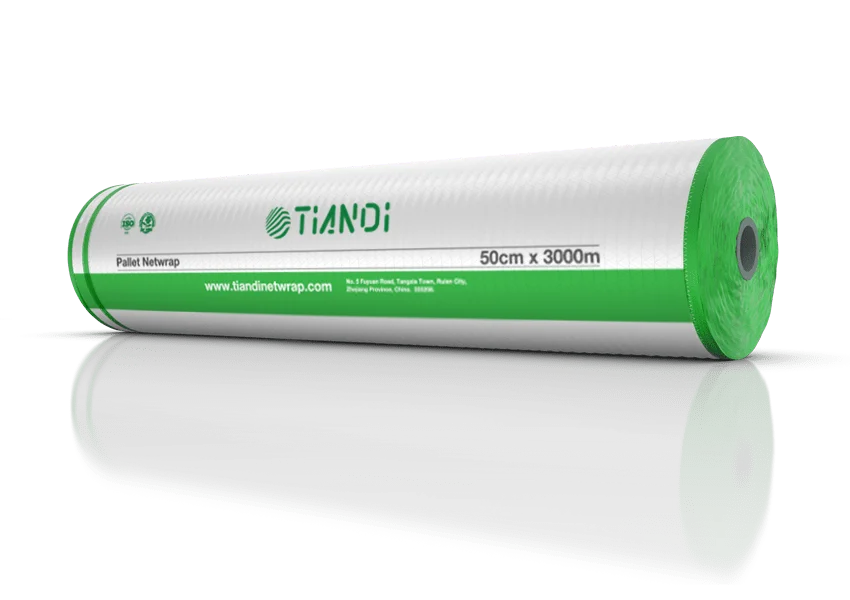
Pallet net wrap and stretch film both stabilize loads, but they solve different packaging problems. Stretch film creates a continuous barrier; knitted net wrap holds the stack while allowing airflow. The right choice depends on whether the load needs ventilation, a sealed surface, or a balance of both.
How the two materials work
Stretch film is a solid LLDPE sheet applied in overlapping layers. Its containment force comes from elastic recovery, so a pallet commonly receives 15–20 passes. It is a practical choice for uniform, dry cartons and loads that need protection from dust or outside moisture.
Pallet net wrap is an open-weave HDPE mesh. Tension is carried by knitted filaments, so three to five passes is a useful starting point for many loads. The mesh is not a film and does not seal the pallet. See how open-weave pallet netting works for the construction details.
| Evaluation factor | Stretch film | Pallet net wrap |
|---|---|---|
| Structure | Solid continuous sheet | Knitted open-weave mesh |
| Typical passes | 15–20 | 3–5 starting point |
| Airflow | Effectively sealed | Air moves through the load |
| Irregular stacks | Can bridge corners and gaps | Conforms to uneven loads |
| Dust or rain barrier | Yes | No |
| Price per kilogram | Usually lower | Usually higher |
| Material per pallet | Usually higher | Usually lower |
Airflow, material use and cost
Ventilation is the main reason buyers compare pallet net wrap with stretch film. Produce, bagged feed, fertilizer and freshly packed goods can release moisture after wrapping. A solid film layer can trap that moisture against cartons or bags. Open-weave netting lets air move through the stack, although it is not a substitute for cooling, humidity control or a weatherproof cover.
Net wrap can also reduce material use because fewer passes are needed. A useful way to compare products is to measure grams per pallet, seconds per pallet and disposal cost over a representative production week. Do not compare price per kilogram alone: net wrap may cost more per kilogram while consuming less material per load.
Any savings are operational rather than guaranteed. A well-tuned film wrapper on stable cartons may already use little film, while a heavy or unstable load may need more net passes than the starting point above. Treat the figures as a trial plan, not a performance guarantee.
Which material fits the load?
Choose pallet net wrap when the load is irregular, bagged, ventilated or difficult to inspect after wrapping. Elastic netting suits mixed-height stacks and loads that settle; non-elastic netting suits more rigid, uniform stacks. The Tiandi pallet netwrap range lists standard widths and roll combinations, with custom options available for a defined packaging requirement.
Choose stretch film when the load needs a dust-tight or moisture-resistant barrier, travels exposed to rain, or consists of stable cartons that benefit from a continuous surface. Netting should not be described as waterproof or as a universal replacement for film.
How to run a controlled trial
- Select one SKU with a measurable issue, such as condensation or high film consumption.
- Record current grams per pallet, wrapping time, pass count and damage at dispatch and receipt.
- Run pallet net wrap on the same SKU with the carriage set for its width and pre-stretch reduced.
- Compare cost per pallet, labor time, disposal and receiving condition over a comparable period.
- Confirm the final specification with pallet dimensions, load weight, wrapper type and required storage conditions.
For breathable alternatives, compare vented pallet wrap and punched film. If you need a product recommendation, send the load and line details to Tiandi for a specification review.
The practical rule is simple: use net wrap when containment and airflow matter together; use stretch film when sealing the load matters more.
Frequently Asked Questions
- Is pallet net wrap a direct replacement for stretch film for pallet wrapping?
- For most bagged, crated and ventilated loads, yes. It is not a replacement where the load must be sealed against outside dust or moisture, because open mesh does not form a barrier.
- Does pallet net wrap cost more than stretch film?
- Per kilogram, net wrap is typically more expensive. Per pallet, it can be lower because it secures a load in fewer passes and uses less material. Compare measured cost per pallet rather than price per roll.
- Can I run pallet net wrap on my existing stretch wrapper?
- In most cases, yes. Standard turntable and rotary-arm wrappers can accept net wrap after the carriage is set for the net width and pre-stretch is reduced. Film-break sensors may need adjustment.
- Why can stretch film cause condensation on some pallets?
- Solid film seals the load almost completely. Moisture already inside the load can condense against the film, while open-weave netting allows air and moisture to move through.
- How many wraps of pallet net wrap does a pallet need?
- Three to five passes is a common starting point for a standard pallet, but the correct count depends on load weight, stack stability, net construction and the wrapper settings.
- Is pallet net wrap recyclable?
- It is made from HDPE, but recycling acceptance varies by region and waste contractor. Confirm the local collection requirements before specifying the material.