

How Bale Net Wrap Works in a Round Baler
Learn how bale net wrap works in a round baler — brake tension, bale rotation, net spread, automatic cutting and discharge explained step by step.
August 19, 2026
Millions of round bales are secured with net every season, but few operators ever see the sequence that runs inside the chamber once a bale hits its preset diameter. Understanding how bale net wrap works in a round baler is what separates a machine-setting problem from a product problem — and it takes about six seconds of machine time to go wrong. Tiandi demonstrated the same operating questions at AGRITECHNICA 2025, where buyers compared bale netwrap with the machinery it supports.
The single most useful thing to know: the roll does not travel around the bale. The bale keeps rotating and pulls net off the roll, while the baler controls only presentation and tension.
How bale net wrap works in a round baler, stage by stage
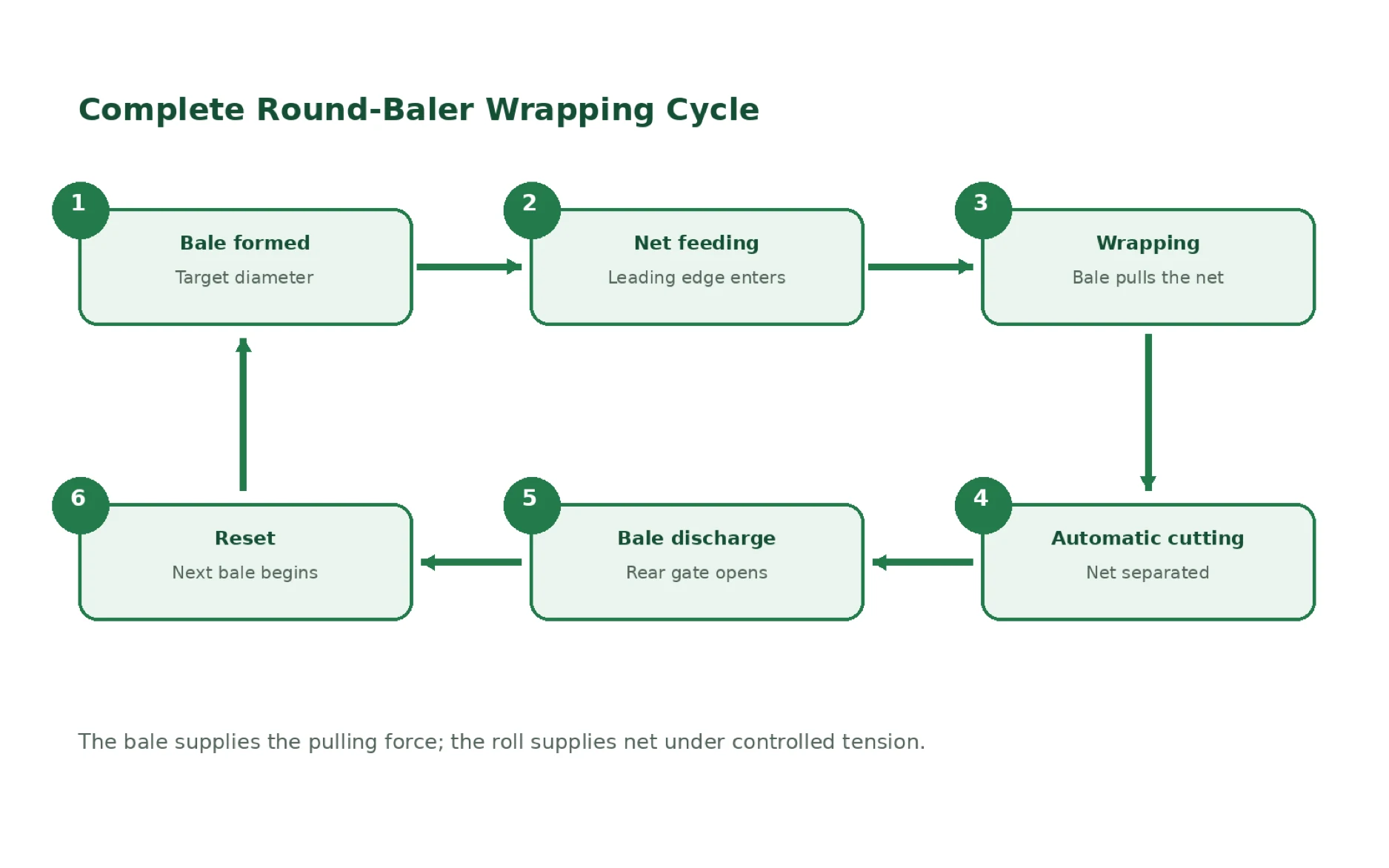
Crop is compressed while the forming bale rotates, and a sensor or mechanical indicator tracks bale size. At the target diameter the machine switches from bale formation to its wrapping program. Designs differ by manufacturer, but the functional order is consistent:
- Crop intake slows or stops, depending on machine design.
- The feed mechanism presents the net's leading edge to the chamber.
- The rotating bale grips the mesh and pulls it across its surface.
- The bale completes the programmed number of revolutions.
- The brake and knife tension and separate the net.
- The rear gate opens, the bale leaves, and the chamber resets.
Unlike twine, which binds along narrow lines, net covers most of the bale width in a handful of revolutions. If you are still weighing the two, the case for net over twine on speed and crop retention sets out the trade-off. If you are planning handling or transport, first estimate how much a round bale of hay weighs under your crop and density conditions.
Stage 1: net feeding and controlled brake tension
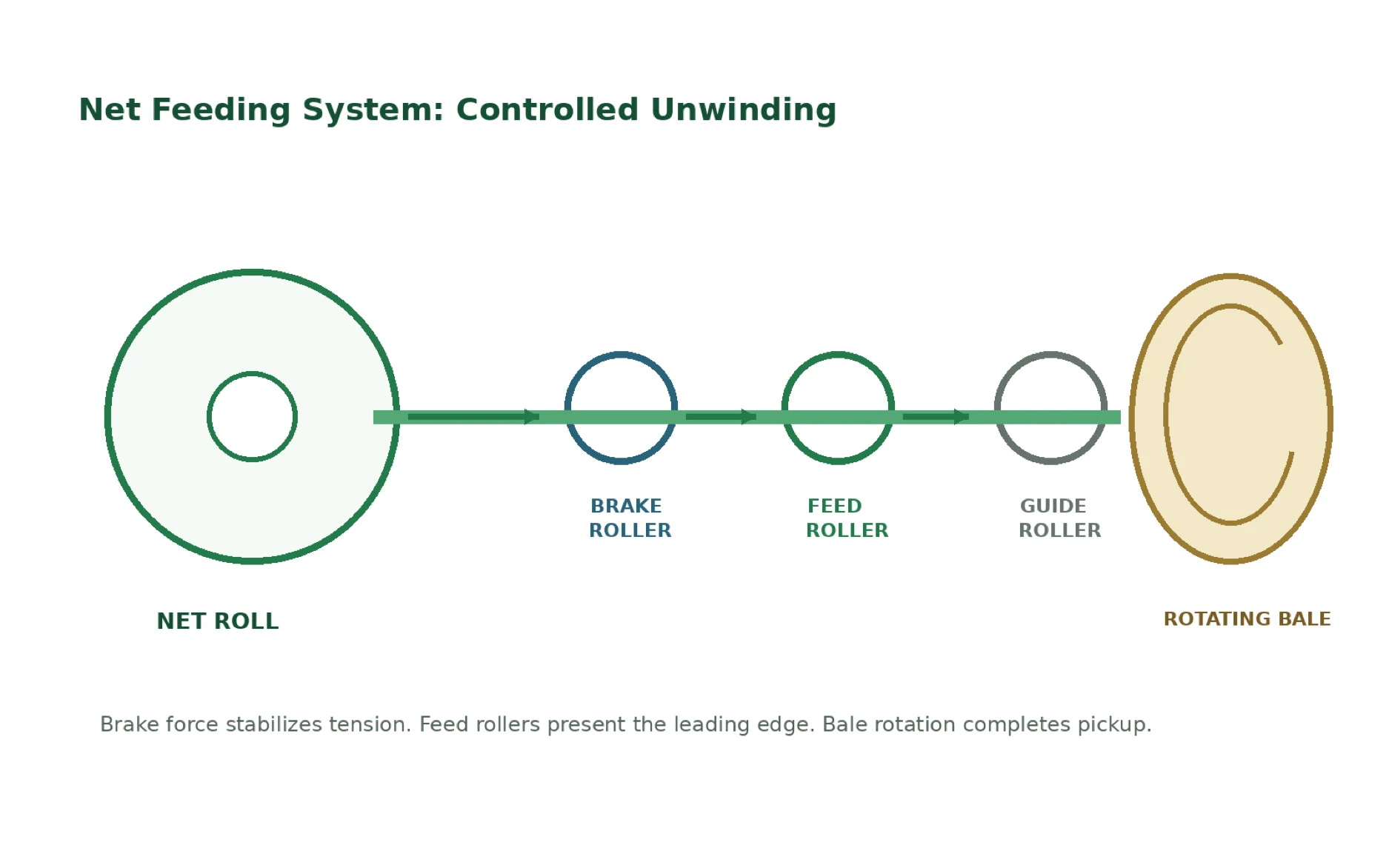
Feeding transfers the leading edge from the storage roll into the chamber. A typical system pairs a roll support and brake with feed rollers, guide surfaces and — on many machines — a spreading device.
The brake creates controlled resistance as the roll unwinds, and both extremes cause failures. Too much braking force stretches the mesh or snaps it before it reaches the bale. Too little lets the roll overrun, so slack net folds, skews or wraps a roller. Feed rollers must be clean, aligned and able to present a straight edge — which is why correct roll orientation when loading matters more than operators expect.
Winding geometry matters here too. Uneven winding, soft edges or telescoping change unwinding resistance, so a roll with perfectly adequate tensile strength can still feed badly.
Stage 2: wrapping and spread across the bale width
Once the leading edge reaches the chamber, friction from the rotating bale grips the mesh. The bale supplies all the pulling force; the roll releases net under resistance. The mesh travels around the circumference and spreads across the face.
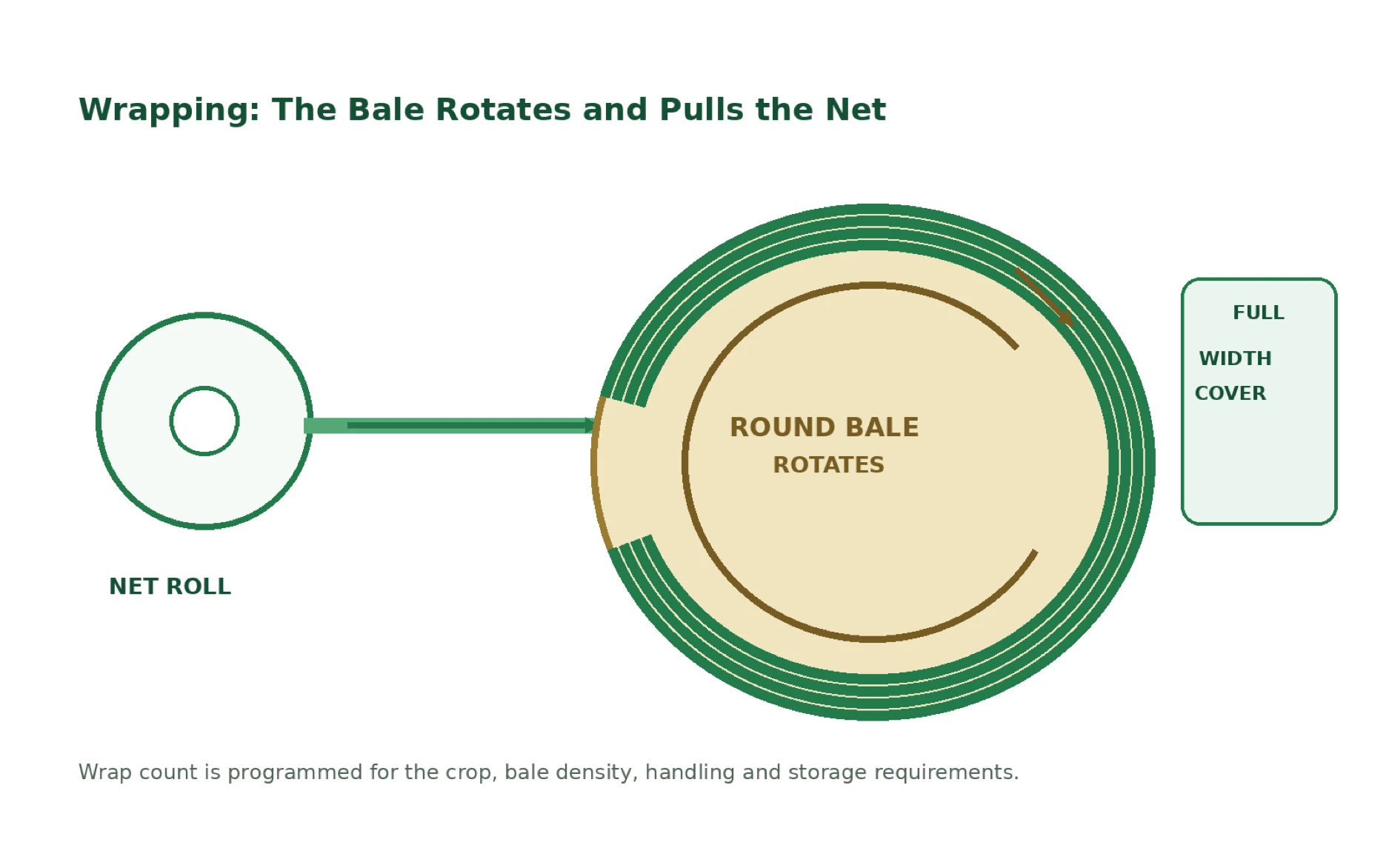
Wrap count is an operating choice, not a constant — crop, density, diameter, handling and storage all shift it. Spreading matters just as much. The net should reach both shoulders without unstable folds, and roll width matched to your chamber is the first thing to confirm when shoulders come out exposed.
Stage 3: how the automatic cutting system separates the net
After the programmed revolutions, the knife or cutting bar moves against the tensioned mesh, with the brake holding the net flat so the edge can separate it.
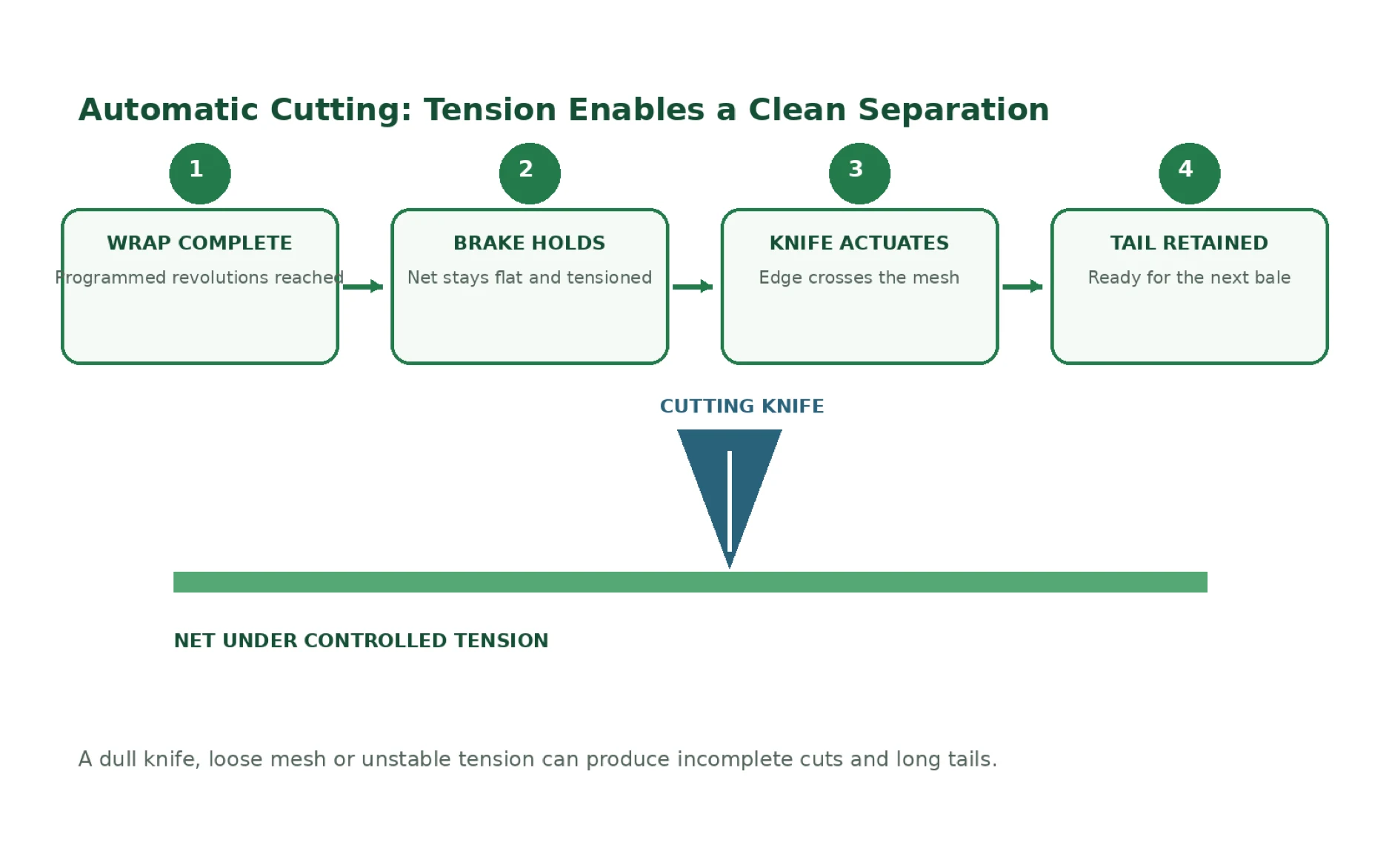
Four conditions have to hold at the same moment: a sharp knife, correct tension, flat mesh, and consistent feed until separation completes. A worn or resin-coated knife leaves connected strands; slack mesh drifts away from the edge; excess tension invites premature breakage. Inspect knife, brake, rollers and net path before concluding a roll is defective — if the net keeps tearing across several rolls, the pattern usually points at the machine.
Stage 4: discharge and chamber reset
With the cut complete and the wrap settled, the rear gate opens and the bale rolls out. Timing is the whole point: discharge before the net has separated and seated can disturb the final layer or drag extra mesh off the roll.
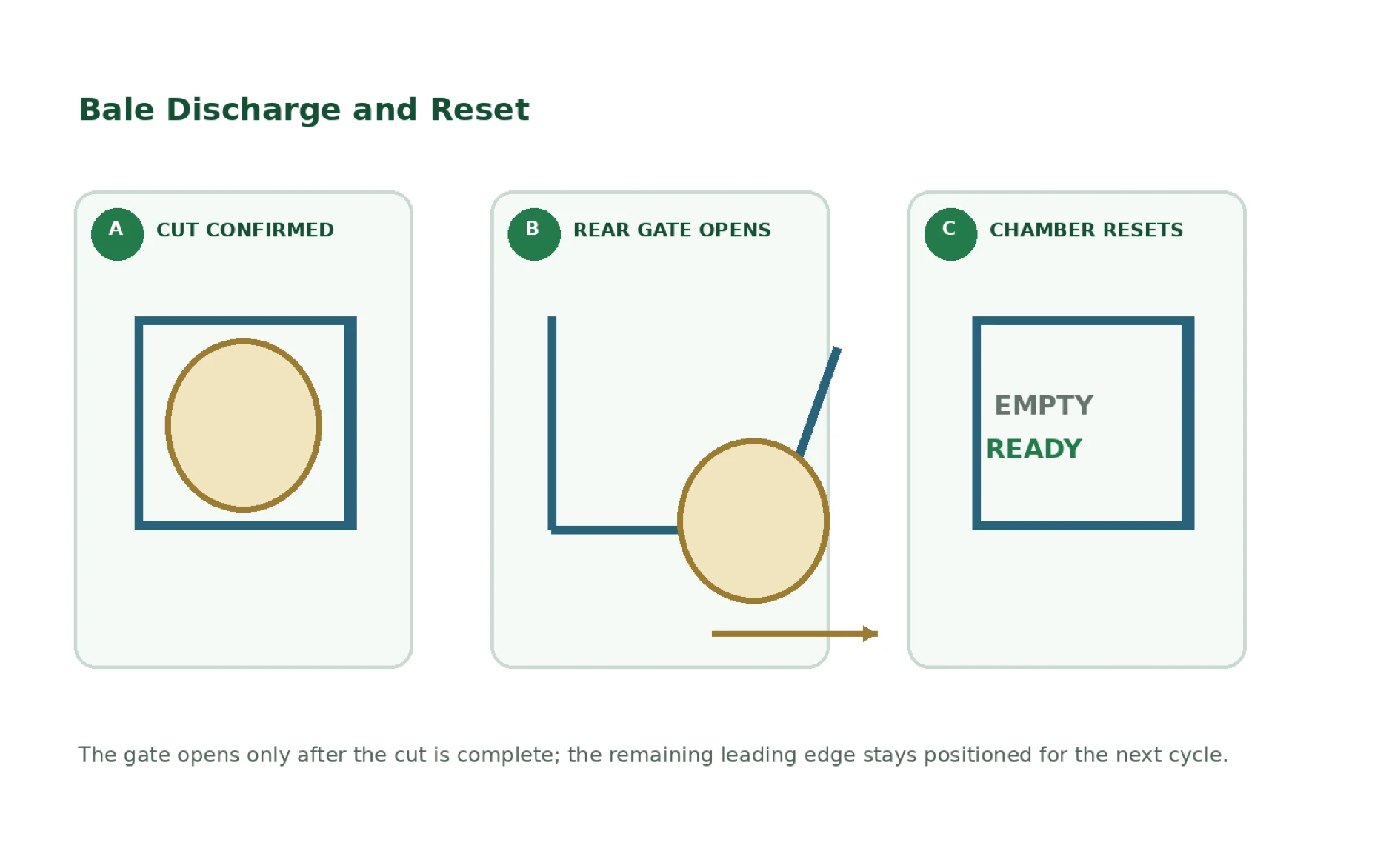
The machine also has to leave the remaining leading edge positioned for the next cycle. Gate closes, intake resumes. Modern balers coordinate this automatically — but only if the roll was installed correctly and the feed path is maintained.
Where the cycle breaks, and what to check first
Work from the manual and the simplest observable cause. Change one setting at a time and record the result.
| Symptom | Likely cause | First check |
|---|---|---|
| Net breaks during feeding | Brake tension too high; damaged roller | Reduce brake setting; inspect the full net path |
| Net will not spread | Wrong width; contaminated rollers | Verify roll spec; clean spreading components |
| Shoulders left exposed | Roll too narrow; poor bale shape | Confirm width against the baler model |
| Knife leaves a tail | Dull knife; insufficient tension | Service the knife before touching the brake |
| Roll telescopes or wanders | Uneven winding; misaligned support | Inspect roll condition and roll support |
Across all four stages, the same product characteristics keep showing up: uniform winding, accurate width, stable mesh geometry, balanced strength and elongation, and UV protection specified for the destination climate. Consistency across the roll and between batches does more for field uptime than one impressive datasheet figure.
Before ordering for a machine you have not run net on before, work through the six-point baler compatibility check — core size, maximum roll diameter and roll weight decide the fit as much as width does.
If a specific baler model is giving you trouble, compare it against the Tiandi baler netwrap range or send us the machine and roll details and we will confirm compatibility before you order.
Frequently Asked Questions
- How many wraps should a round bale have?
- There is no single correct number for every operation. Follow the baler manufacturer's guidance, then adjust for crop, bale density, handling intensity and storage method. The aim is enough restraint and edge coverage without burning net you do not need.
- Why does the net not reach both bale edges?
- The usual causes are a roll that is too narrow for the chamber, incorrect threading through the spreading path, contaminated or worn spreader components, or a bale that is not forming to a uniform shape. Check roll width against the baler specification first, then the net path.
- Why does bale net wrap break before wrapping even begins?
- Excessive brake tension is the most common cause, followed by a damaged or burred roller, an incorrect net path, or transport damage to the roll edge. Where the break occurs on the net path is usually the fastest clue to what caused it.
- Why does the knife fail to cut the net cleanly?
- A clean cut needs a sharp knife, mesh lying flat, and correct tension at the moment of actuation. A dull or resin-coated knife leaves connected strands; slack mesh moves away from the cutting edge. Service the knife before increasing brake tension to compensate.
- Can one bale net wrap roll fit every round baler?
- No. Width, core size, maximum roll diameter and net routing vary between machines. Confirm the roll specification against the exact baler model before ordering, particularly when switching supplier or brand.
- Does higher tensile strength always mean better field performance?
- No. Reliability comes from a balance of strength and controlled elongation, plus stable winding, accurate width and consistent mesh geometry. A very stiff, very strong net can feed poorly, spread badly and cut unreliably.