
How Bale Net Wrap Is Manufactured: Resin to Finished Roll
How bale net wrap is manufactured, stage by stage — resin and UV additives, extrusion, filament drawing, warp knitting, inspection and controlled roll winding.
August 22, 2026
A finished roll of net wrap looks like a simple commodity, which is why it is usually bought on width, length and price. Understanding how bale net wrap is manufactured explains why two rolls with identical printed specifications can behave completely differently in the baler — and which questions actually separate a reliable supplier from a cheap one.
Performance is built in at every stage, not inspected in at the end. Resin sets the material ceiling, drawing decides filament consistency, knitting builds the mesh, and winding preserves all of it through delivery.
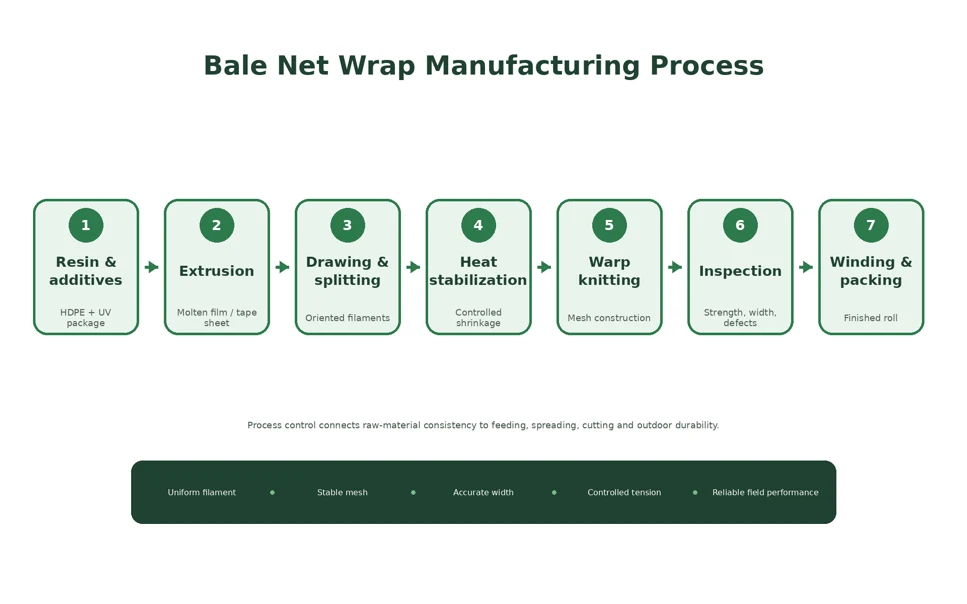
How bale net wrap is manufactured, stage by stage
Production runs as a continuous chain, and each stage constrains what the next one can achieve.
You can see the same logic from the other end of the chain: most of what governs how the net behaves during the wrapping cycle was decided here, on the production line.
Resin and additives set the ceiling
Production begins with a controlled polyethylene blend. Virgin HDPE is commonly the structural base, because molecular orientation during drawing turns it into strong, lightweight filaments.
The resin is then combined with a UV-stabilisation package, antioxidants and processing aids. Two things matter more than the headline percentage: the package has to suit the destination climate and expected outdoor exposure, and dosing has to be clean and thoroughly mixed. How that climate translates into a number is covered in specifying UV stabilized bale net wrap by market. Additive variation inside a single roll produces weak sections and uneven weathering — the kind of fault that only appears months later in the field.
Extrusion and drawing decide filament consistency
The blend is melted and homogenised in an extruder, then formed through a die into a thin sheet and cooled to lock in a uniform profile. At this point thickness control matters far more than appearance: a thick band becomes an oversized filament later, a thin band becomes a weak one.
The cooled sheet is slit into narrow elements and drawn through a controlled heating and stretching sequence. Drawing is where strength actually comes from — but the target is not maximum strength. Over-drawing costs elongation and leaves filaments brittle; under-drawing leaves them soft and variable. Draw ratio, temperature, line speed and filament dimensions are controlled together, because a single weak filament is where a break during feeding starts.
After drawing, filaments are heat stabilised to control residual shrinkage, then guided and tensioned for knitting. Inconsistent tension here shows up later as uneven mesh openings, tight bands or loose lanes.
Warp knitting builds the mesh and the edges
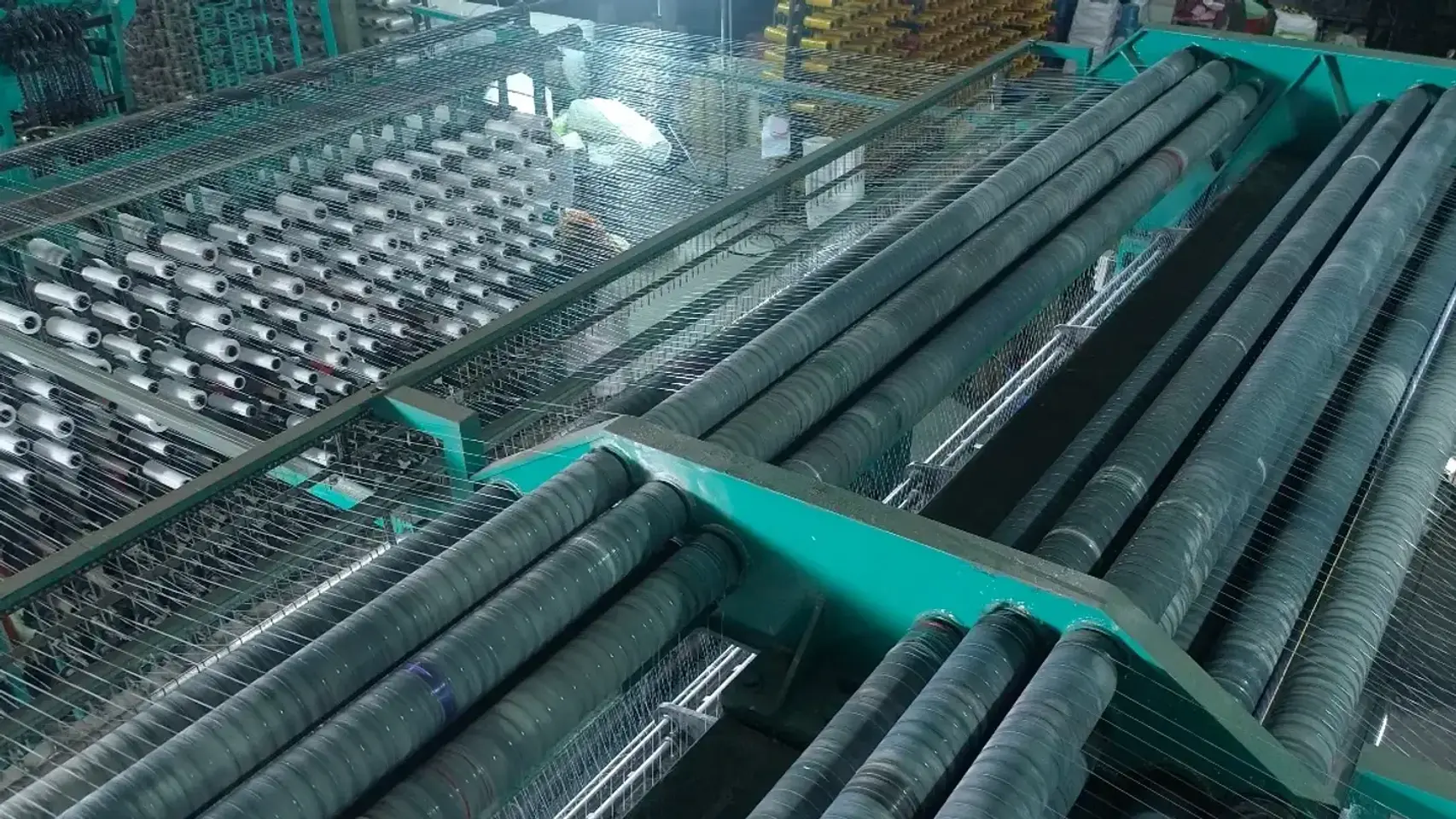
In warp knitting, filaments are interlocked into the familiar net structure: longitudinal load-bearing chains with connecting elements across the width. Edge construction is often reinforced so the roll can cover bale shoulders without tearing or curling.
Mesh geometry is an engineering choice, not a default. The number of longitudinal elements, the connection pattern and material distribution together determine spreading, puncture resistance, crop retention and how cleanly the net cuts. Machine gauge, guide-bar movement, yarn tension and line speed all have to stay synchronised — a mesh that looks acceptable can still perform badly if it is unbalanced, or if the edges behave differently from the centre.
Inspection, winding and packaging protect the result
Checks run during production and on finished samples: width, mass per unit area, roll length, tensile and elongation behaviour, mesh consistency, edge condition and visible defects. Useful quality control connects those measurements to field consequences rather than filing them — width variation means exposed shoulders, weak lanes mean breaks under brake tension, unstable mesh means poor spreading.
Winding is the stage most often underestimated. The mesh is wound onto a core under tension that usually has to be managed as the roll diameter grows, not held at one setting. Too much compacts the mesh; too little or uneven tension causes telescoping, soft sides and unstable feeding. Packaging then protects the roll from moisture, dirt and handling damage — a crushed core turns a conforming net into a feeding problem at the customer's machine. Our production and process controls follow this same sequence.
What buyers should ask for
Specifications that only state nominal width, length and tensile strength describe an average, not a guarantee. Ask how consistency is controlled from batch to batch, and which test methods and tolerances sit behind each number.
| Control point | What it governs | Field symptom when it drifts |
|---|---|---|
| Resin and additives | Toughness and outdoor life | Premature breakage or weathering |
| Filament drawing | Strength and elongation balance | Breaks under wrapping tension |
| Knitting tension | Mesh and edge uniformity | Poor spreading, exposed shoulders |
| Width and winding | Baler compatibility and feeding | Telescoping, tracking or cutting faults |
This is also the fastest way to read a complaint. When the net tears repeatedly across several rolls, the pattern usually points back to one of these four control points rather than to the machine.
To match a specification to your baler, crop and climate, compare the Tiandi baler netwrap range or send us your requirements and we will confirm what the roll needs to do before you order.
Frequently Asked Questions
- Is bale net wrap made only from HDPE?
- HDPE is normally the main structural polymer, but a formulation can include other compatible polyethylene components and additive masterbatches to hit processing and performance targets. The blend is a design decision, not a shortcut — it tunes impact resistance and how predictably the material runs on the line.
- Why does filament orientation matter so much?
- Drawing aligns the polymer molecules along the filament, which raises strength in the direction the net is loaded. That is how a lightweight mesh can hold real wrapping tension. The process has to stop short of maximum orientation, though, or the filament loses the elongation and toughness it needs in the field.
- Can two rolls with identical dimensions perform differently?
- Yes, and this is the most common surprise for buyers comparing quotations. Resin quality, mesh design, edge construction, width tolerance and winding stability all vary between products whose printed width and length are the same.
- Does the colour of the net provide UV protection?
- No. Outdoor life comes from the UV-stabilisation package, how well those additives are dispersed, their compatibility with the resin, and the extrusion and drawing conditions. Adding colour does not create UV resistance, and the package should be specified for the destination climate.
- What does batch traceability actually give a buyer?
- It lets a complaint be tied back to specific resin lots, machine settings, operators and inspection records. Without it, a field problem cannot be diagnosed beyond replacing the roll, so the same fault can recur in the next shipment.