
UV Stabilized Bale Net Wrap: How to Specify by Market
Why UV stabilized bale net wrap needs a market-specific spec: what sunlight and heat do to filaments, what a stabilizer system contains, and how to test it.
August 27, 2026
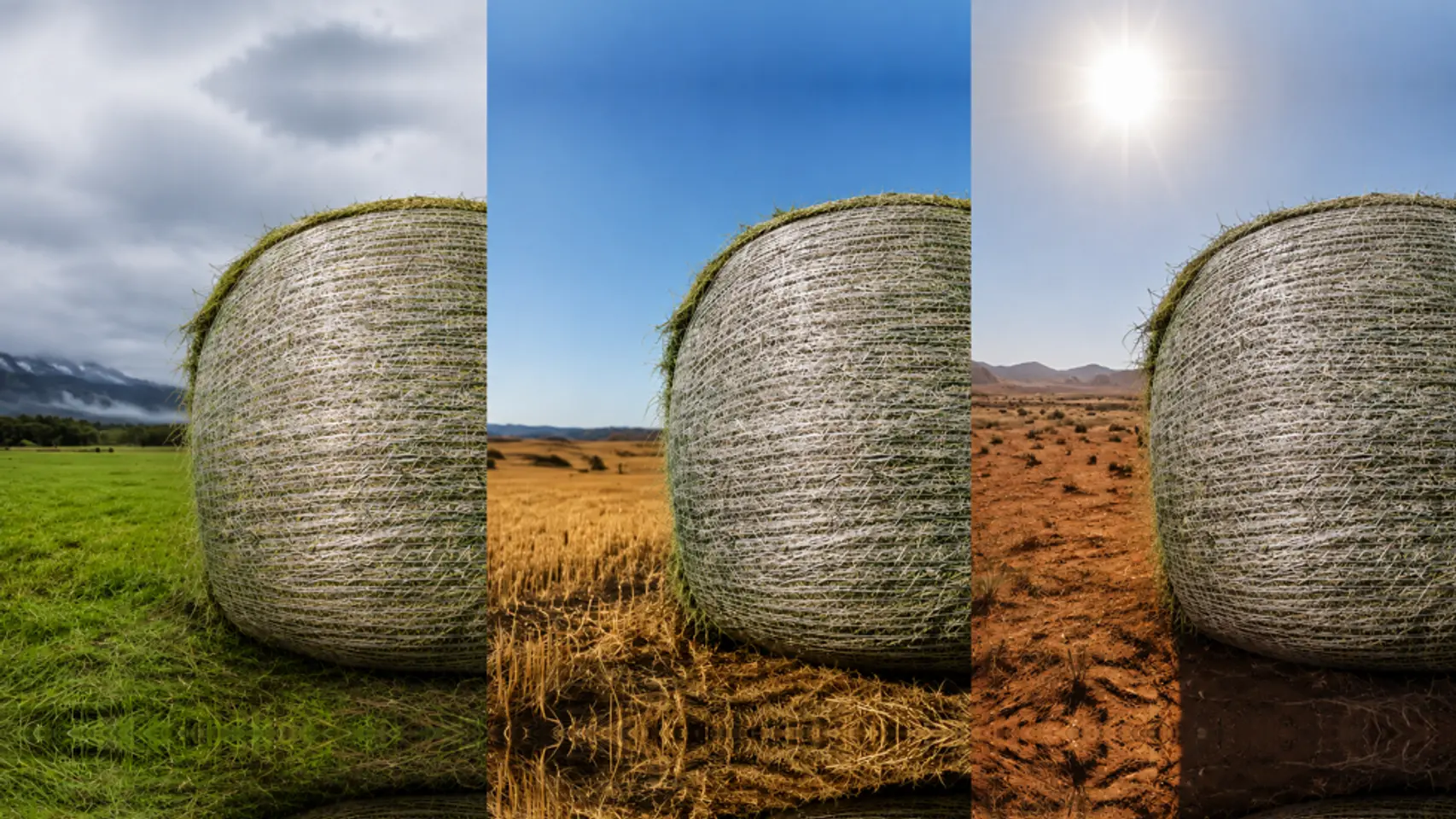
A roll of bale net wrap can spend three weeks under a shed roof, or ten months on an uncovered bale in full sun. The polymer, mesh geometry and roll dimensions can be identical in both cases, and the outcome still will not be. That is why UV stabilized bale net wrap is specified against a market rather than against a universal outdoor-life figure printed on a datasheet.
Four inputs decide it: radiation intensity, temperature, exposure duration, and a stabilizer system that has to survive all three.
What UV does to polyethylene filaments
Solar ultraviolet spans 100–400 nm, and WHO divides the spectrum into UVA (315–400 nm), UVB (280–315 nm) and UVC (100–280 nm). Atmospheric absorption stops solar UVC before it reaches the ground, but UVA and UVB both reach the bale, and where oxygen, heat and susceptible chemical sites are present they initiate photo-oxidation in polyethylene.
A thin oriented filament has very little material to spare. Oxidation cuts molecular weight and elongation, and the filament turns from tough to brittle: surface crazing, cracking, then breakage under ordinary handling loads. Research on HDPE shows that raising either UV intensity or temperature accelerates photodegradation, which is why a hot, bright market cannot be judged on daylight hours alone.

It also explains why weathered net tends to fail at the loader rather than in the stack. When net keeps breaking during handling, exposure history belongs on the list of causes alongside brake tension and knife condition.
Why UV stabilized bale net wrap is a market decision
A specification starts with where the product goes and how it is used: region, harvest season, outdoor storage period, sheltered or fully exposed bales, ambient temperature, altitude and handling cycle. Pigment belongs in that list too, because colour changes both light absorption and surface heat build-up.
The WHO UV Index is designed for human exposure, not polymer lifetime, but it is a usable first screen on how severe a market is. The published figures show how far apart markets sit — and how far apart two regions of one country can sit.
| Data point | Published value | What it means for the specification |
|---|---|---|
| WHO UV Index bands | 1–2 low; 3–5 moderate; 6–7 high; 8–10 very high; 11+ extreme | A screening indicator, not a conversion into service life |
| Australia, June–July average | Below 2 in Tasmania, close to 8–9 in the far north | One country can need more than one exposure class |
| New Zealand summer maximum | Typically about 12, above 13 in the far north; winter peak 1–2 | Production date and storage duration become part of the spec |
Australian averages come from the Bureau of Meteorology UV Index maps and the New Zealand figures from Earth Sciences New Zealand. Both are environmental context: neither predicts how long a given net will last without material testing correlated to field results.
What a stabilization system actually contains
UV protection is a system, not an ingredient. Hindered amine light stabilizers (HALS) interrupt the free-radical cycles that drive degradation. UV absorbers and selected pigments reduce the radiation reaching vulnerable sites in the polymer. Antioxidants protect the resin during extrusion and against later thermal oxidation.
What that system delivers depends on stabilizer quality, dose, dispersion, compatibility with the polyethylene blend, and resistance to extraction or chemical interference. A nominal percentage says little on its own, because it is a masterbatch dose diluted by an unstated active content and carrier. Processing can undo the rest — overheating during extrusion or poor mixing weakens an otherwise sound package.
For thin monofilaments, dispersion and batch consistency decide field results. A good average hides local areas of low stabilizer concentration, and those are where a filament cracks first, which makes additive dosing and mixing control on the production line as much a part of the specification as the formulation.
How to specify exposure classes instead of one global claim
Replace the single universal claim with two or three classes, and let the destination select one:
- Temperate, short storage — seasonal outdoor use at northern-European latitudes, bales consumed within the season.
- High UV — Australia, New Zealand, southern Africa and the southern United States: a stronger stabilizer package and tighter retention criteria.
- Long storage — twelve months or more outdoors, where heat, bale orientation and whether rolls were sheltered before use all count.
Every class needs a declared test method and a retention target rather than an adjective. Accelerated weathering under ISO 4892-3 or ASTM D4329 gives a controlled comparison between formulations under a stated cycle; it becomes a service life only with outdoor correlation. Ask for the cycle, the retained-property criterion, and the field data behind the claim. If the product itself is new to you, what bale net wrap has to do on the bale explains why retained elongation matters as much as retained tensile strength.
Outdoor life is engineered, not promised: resin and stabilizer matched to a defined market, exposure period and measurable target, then held there by clean dispersion, disciplined processing and declared testing. Send us the destination, harvest season and expected outdoor storage period and we will specify against it — start with the Tiandi baler netwrap range, or send us your market and storage details.
Frequently Asked Questions
- Does a higher UV-additive percentage always mean longer outdoor life?
- No, and buying on that number is one of the easier ways to be disappointed. The figure is a masterbatch dose, not an active content — so the same percentage can carry very different amounts of working stabilizer. Chemistry, dispersion, compatibility with the resin, processing history and the actual exposure environment all move the result more than the headline number does.
- Can accelerated-weathering hours be converted into years of field life?
- Not reliably. Laboratory exposure under a declared cycle is a controlled way to compare formulations and to qualify a product against a criterion. Turning those hours into a service life requires outdoor correlation data from a comparable climate, and any supplier quoting a straight hours-to-years conversion should be asked what that correlation was.
- Is one specification suitable for all of Australia, or all of Europe?
- Not necessarily. Latitude, altitude, season and outdoor storage period vary widely inside a single country, and the published UV Index data shows differences within Australia as large as the differences between countries. Where a supply covers a wide geography, two exposure classes are usually more honest than one averaged package.
- What should I tell a supplier so they can specify the UV package correctly?
- Destination region, harvest season, how long bales stay outdoors, whether they are sheltered or fully exposed, typical ambient temperature, and how often bales are handled before use. Net colour and expected storage orientation help too. With those, a stabilizer package can be matched to a declared retention criterion rather than guessed at.